ACoJB prides itself on *positive attributions* towards the journey of healing and wellness, which involves the client’s truth and balance focusing on a more holistic approach to life, love, and personal responsibility. It's a *bittersweet blend* of Bay Area grit mixed with PTSD, sexual trauma, college education, advocacy for systems change, peer support, healing, wellness, and unconditional love.
#CupOfJoBruno (ACoJB) style rant: The topic of discussion is peer support, lived-experience, system change, and business management. When I became homeless in 2019, I took my wisdom of peer support and my wellness action plan to stay well while in crisis. It worked for me. It worked so well, I created a Housing Action Plan specifically for people who were homeless, receiving systemic assistance, and ready to find their own wellness. In so doing, I created Delta Peers; a potential nonprofit that would become the network for peer specialists throughout the Bay Area; we want to be unionized so we are properly paid for our work. The system and nonprofit sectors ate it up and kept using my story and my wisdom to better their systemic process; meanwhile, it left me still without housing and in financial insecurity. It was five years of using my story and my advice, but never received stability from my work.
What I call The Pivot of 2025, I decided to leave the nonprofit sector and focus my intention on business management so I can promote the guided-storytelling side of system change and public policy. Nothing About Us Without Us! If someone is writing policy about a specific group of people, the voice of The People needs to be spoken and given respect to policy change. Those of us with lived-experience are The People. Delta Peers was specifically for that purpose; to give those with experience the voice for system change. It didn’t work so well for me. I needed to change direction and in so doing, I found that my own lived-experience and expertise of the systemic process can be utilized for The People instead of the system.
Using the ACoJB Wellness Toolkit, self-published by ACoJB, participants can utilize one-on-one or group facilitation where I provide an opportunity for people to gather their story in a specific, peer support way and use it for system change. Not only can I guide someone through their story and pull out the essential pieces to use for system change, I can guide them through grief, sorrow, regret, and even goal setting, vision boards, and a wellness toolkit that can help them stay well like mine did when I was homeless. ACoJB can guide participants to whatever governing board they’re experienced in and we will work close together to show step-by-step ways they can change public policy with their story.
The ACoJB Wellness Cafe is the end game for my intention of turning my brand into a place of business. It’s how I will use my lived-experience and guide others through their story. It’s where I will provide massage and other metaphorical practices. It’s where I will provide internship opportunities for upcoming students in peer support and massage. It’s where I will provide community needs like a food bank, clothing closet, and a pool table for building youth community. The Wellness Cafe is where people can come and fill up their cup by drinking from mine. A Cup of Jo Bruno is a bitter-sweet blend of Bay Area grit, an education, and a passion for policy change.
This current brew is focused on business marketing and management
I’ve enrolled in school again. I have an AA in journalism, BS in anthropology, over 900 hours of massage therapy training, and I was valedictorian of the peer support program I graduated from. The best kind of support I ever received was when I was a student, so I’m going for my certificate in business management so I can get the proper education on how to run a successful business. I’m exhausted from survival tactics, ups and downs in finances, and the constant need to fight my way through life. I want stability. I want consistent income. I want true friendship and support. Being in recovery for just over 20 years has taught me more about myself and what I want out of life that I cannot, I will not, give up on my dreams. And my biggest dream, outside of personal stability, is to help others tell their story. So, here I go again!
Delta Peers has been dormant for two years and ACoJB Consulting is 20+ years in the making. Let’s roll!
If someone from your business is interested in joining one of our cohorts, please reach out to me and we’ll waive the ticket fee if you donate.
Another way your business/organization can sponsor this work is by providing space to conduct the workshop(s).
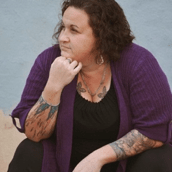
Jo Bruno here, Peer Support Specialist, Lived-Experience Advisor and Self-Published Memoirist. I’m also the founder of Delta Peers and branded a #CupOfJoBruno (ACoJB); a bitter-sweet blend of peer support, resiliency, hope, and a passion for policy change. After graduating with a Bachelor’s of Science in Anthropology (2014), I traveled the 11 western states, where I quickly found myself in crisis. I saw crisis after crisis and became homeless in the City of Antioch in late 2019 as I fled domestic violence. I had lost all hope. I was suicidal. I was chronically depressed with no support and I didn’t know where I was going to eat, take a shower, or even sleep some nights. I was one of the lucky ones though, sleeping in my car for a year and a half, not in doorways or in a tent. I kept dry when it rained, many others did not.
While homeless, I put my anthropological studies to work and treated it like a field study; the start of a written thesis for my Master’s Program in Public Policy. Right as COVID took our freedoms and encouraged everyone to stay home, I lost all public support. No public restrooms. No restaurants. No parks. Nothing was available except the darkest of human desperation. I treated the experience, while battling my depression and addictions, as an opportunity to learn something about a community I didn’t know much about; the homeless. With my observation and study throughout my experience and while still in recovery of my homelessness, I created and self-publishedThe Delta Peers Housing Action Plan Workbook.
Peer Support has always been a part of my life, I tend to lean toward self-reflective practices while managing my emotions and dark childhood memories. I’ve always sought out others who I can relate with and who understood me through my traumas instead of casting judgment against me and my behavior. Things didn’t always work out for me, which is why I’ve dedicated my adult life to Delta Peers and the Housing Action Plan. It’s mine; something I produced. As I used my wellness tools to get myself out of homelessness, I was voted as the Lived-Experience Advisor for the Contra Costa Council on Homelessness where I sat for 4 years. I used my story and my skill to change public policy. Through my recovery of homelessness, I was accepted to the SPIRIT (Service Provider Individualized Recovery Intensive Training) program at Contra Costa College, where I graduated valedictorian (2021) and created theConstitution of Intentfor Delta Peers. It’s the document that holds us accountable for the intentional peer support we provide.
I know my story changed policy in the county I was born and raised in. I know I influenced our system of care, and I intend on continuing that throughout the 9 Bay Area Counties, maybe even statewide. My grandmother would be proud. She’s always told me I was a born leader. So, in her memory, now I lead! I am a third generation born in Pittsburg, and it was my Bruno family that built the sister city to their home town in Sicily. Antioch 94509, however, has a special place in my heart since my vibrant street life in the early 2000s. Just north of Highway 4, I was well involved in many influential positions as I worked the streets from mid 1990s to 2016. I eventually left the street life and went to college to study journalism, graphic design, writing, and anthropology. I came back home to build an establishment. I failed. Then, failed again. But, I’m moving forward now. This is where you come in. I’m here today, asking you for support. I’m seeking donations from small and large businesses who want to support Delta Peers (ACoJB) and help build a peer foundation for the unhoused communities.
The Delta Peers Housing Action Plan is a 9-week course that focuses on housing insecurities and peer support. I will facilitate the program with fellow SPIRIT graduates. The Housing Action Plan is a step-by-step workbook, self-published under ACoJB, that guides an individual who is using housing resources to articulate their needs and self-reflect on their behavior when it concerns their housing journey. It is not a program to help anyone find housing even though that’s what we need (2024 PIT Count), but instead focuses on the individualized stories to find hope as they’re looking for housing. The 9-week course is structured in a way that provides intentional peer support for both the service provider and the person they’re serving. It’s a bridge between housing and behavioral health. It’s the glue that puts lived-experience into the fundamental discussions around homeless and housing policy. Even though the Housing Action Plan is very personalized, the sessions are done in groups with interactive art projects. It mirrors the Wellness Recovery Action Plan (WRAP), but has a focus on housing that WRAP doesn’t have.Becoming a financial sponsor of Delta Peers comes with clout because I have established a name for myself throughout the Bay Area and surrounding communities when it concerns the discussion of lived-experience and homelessness. Nothing About Us Without Us! I am the lived-experience advisor, representing Contra Costa County, Antioch specifically as I visit other counties.
So, if your pledge is $200 or more, as I continue to pitch the 9-week Housing Action Plan to housing service providers throughout the Bay Area, your logo will be present on all print and social media publications that ACoJB creates, including a most up-to-date print of the Housing Action Plan Workbook.
The goal is to bring the program statewide and have it implemented in all shelters. Also, you’ll have the opportunity to get involved with more in-depth discussions about how you and your business can help reduce homelessness by 75% in California per Gov. Newsonrequest. We know it takes a village to raise a child, and it takes overlapping communities and businesses to end homelessness. Will you support us?
The financial support you give today will cover multiple cohorts tomorrow. To make sure Delta Peers has covered all wellness tools and topics for the Housing Action Plan and before I pitch it to the Bay Area Housing Service Providers, I need at least 30 reviews. In light of this, the Delta Peers team is putting togethertwo 5-hour pilot runs (Eventbrite), July 12 and July 20, 2025. These sessions are the same, and are set up as crash courses of the 9-week cohort structure and outline. We’ll cover all 9 sessions within each 5-hour period so Delta Peers can receive feedback from community members, SPIRIT graduates who have lived-experience of homelessness, and housing service providers.
We don’t have space to work yet and we need something that can accommodate up to 30 people, providing table and chairs and counter space for crafts and food. While dealing with housing insecurities, it’s difficult establishing residency let alone a location to work out of. My resiliency is what’s keeping me motivated and it’s the hope I built within my recovery that gives me courage to ask you, someone I may have never met, for support in making my dreams a reality. Please, share this with your network, your coworkers, your church groups, your family and friends. All donations are helpful, and I look forward to meeting with you if you have any questions, comments, or concerns. Please, don’t hesitate to reach out, and take good care.
If you or someone you know needs help finding housing resources, contact211.
Peer Support Specialist Lived-Experience Advisor Self-Published, Author #CupOfJoBruno DeltaPeers@gmail.com ACoJB.com
Budget for a 9-week cohort
This is for a 12-member cohort with 2 facilitators and a SPIRIT intern. The max amount of people per cohort is 15 members. For special group sessions, we can move it to 20 participants, adjusting rates as needed. In one year, we can do 4 cohorts. This snapshot of the budget reflects 20-hours a week, covering facilitation and administration for both facilitator and co-facilitator.
Workbook & Printing $300
Participation Incentives (food and stipend, provided by service providers) $6,700
Art & Office Supplies (used for future cohorts; costs vary) $600
Facilitation & Administration $9,200
Total: $16,800
GoFundMe Campaign Budget
The two pilot runs are going to be used to solidify reviews and feedback from the community before bringing the Housing Action Plan to other counties within the Bay Area.
Rental space for both 5-hour pilots approx. $900
Printed ACoJB workbooks approx. $300
Supplies: large sticky pads, markers, post-it notes, art supplies approx. $600
Establish 501c3 status and insurance in the City of Antioch approx. $900
The data collected for the Constitution of Intent (2021) was compiled during the The Service Provider Individualized Recovery Intensive Training (S.P.I.R.I.T) internship that I (Jo Bruno) did through Contra Costa College (CCC), Health and Human Services (HHS) and the Office of Consumer Empowerment (OCE). OCE is a department within our Behavioral Health Department.
Already working with the Council on Homelessness (H3), which is a division of the Health Services, I wanted to build a bridge between the two departments in order to capture the lived-experience of homelessness. Strengthening the partnerships already in the Delta Peers network, I conducted outreach by holding community meetings, gathering input from, so far, 26 people. Of those community partners were OCE staff, S.P.I.R.I.T students and alumni, Delta Peers members, Health Leads Housing is Health committee, community members, and county/social workers.
AIM
COMMUNITY COMMITMENT
Inform & Educate
Support for further education:
CEUs
Train the trainer
Cross-Sectional Training (H3/OCE)
Parent/partners know their roles
Peer to department
Peer-Ran Orgs to departments
Provide more access to peer trainings, policy making, advocacy teams, information sessions etc.
Create jobs specifically around facilitating peer trainings to develop advocates who can help others using the system (DP peer navigation)
Peer partners build trust between system and community
Consult, Listen & Relate
Streamline relatable data:
Message of hope and recovery
Promote racial equity
Show problem
What can the community do?
How can community fix problem?
Validating lived-experience gives them democratic authority as a policy maker, changing the system.
Guidance on how one can advocate for themselves while they’re in crisis or utilizing the system.
Peer liaison groups to discuss problems and solutions around BIPOC experiences.
Include & Compensate
Provide incentives for completing programs:
Receive guidance toward skills development into relevant work.
Acknowledge economic inequalities for BIPOCBuild a peer foundation
Find a peer grant writer who has lived-experience
Develop skills already acquired by lived-experience and work history. Resume building/job placements.
Opportunity to try different things with the support of other peers. The work you’re doing is being yourself.
Understanding that creating job skills and acquiring a job may not work, so having guidance and support to other opportunities.
Meet them where they are.
Build Community Partners
Cross Sector language:
Student becomes the teacher
Use peer model to educate others within system/CBOs.
Allow space for youth language, systematic language, etc.
No more alphabet soup dialog
Community mindset, peer coalition. Bringing value to the story of the lived-experience.
Groups of peers go to community members, sharing the current work in the meetings of the system.
Peer partners educate the community while the community gives the peer partner insight to bring back to the system meeting.
Empower Self-Agency
Cross Sector Empowerment:
Peers hired in county positions
Clinicians/social workers need peer support, too.
Encourage peers to become community partners/advocates
UNITE community members with community partners who will connect with peer workers already in the system, which gives the opportunity to educate the system workers who don’t have peer knowledge.
Opportunity to explore emotions of trauma.
Find logical, cognitive understanding of the trauma and how it can change the work place.
INFORM and EDUCATE: Give facts, share information, and provide formative, quality principles (the fundamental truths of peer support and advocacy/advisory). The
S.P.I.R.I.T graduate holds training opportunities to talk about Peer Support in the work-place, becoming peer trainers for their co-workers, facilitating presentations, implementing peer support for the department.
CONSULT, LISTEN, and RELATE: Seeking advice from those with lived-experience, acknowledging that the racial equity perspective is essential; the story-telling aspect. It’s probably the most important part of this entire framework. We would capture the lived-experience perspective from each peer involved with each discussion, bringing it back to the department/committee for them to bring it to the board of supervisors.
INCLUDE and COMPENSATE: Practicing and providing equal access to become part of the whole system of care. When a peer, one with lived-experience, shares their story we compensate for their time. Compensation is on a needs-by-needs basis, meeting the peer where they are, recognizing the inequities of BIPOC (Black, Indigenous People of Color).
BUILDING COMMUNITY PARTNERSHIPS and COLLABORATIONS: The process of working together to create something in agreement. Best practices while coordinating with others not already in the network. Community members are the partnerships we’re building.
EMPOWER SELF-AGENCY: Given the authority of one’s own livelihood. Allowing the process of self-awareness by strengthening their confidence in advocacy work and personal story-telling. Knowing and understanding how their lived-experience can influence the system, they build a sense of identity within their experience and crisis. It doesn’t determine who they are, but rather how they can use what’s happened to benefit their livelihoods.
UNHOUSED LENS: The unhoused community are met by peers who start the relationship with community members who are in crisis. This is building trust with the community member. The peer is the Community Partner, partnering with H3 (or other department/organization), who is doing the community outreach.
NEXT STEPS: Each category listed above will be further explored from community members. There will be ongoing Peer Network meetings through OCE, which will provide opportunities to share input to the constitution. At any time, a community member and/or county worker can suggest edits to raise awareness to other best practices not listed.
Contra Costa Peer Support Constitution of Intent
Proposed Pilot Program:
OCE (peer specialists) and Delta Peers (unhoused population)
Final draft last updated: 10.20.21 (edited by Jo: Next Steps)
So, it saddens me I am writing this! How do I write about destructive masculine energies on a day we are supposed to celebrate women? How do I write about the struggle I am experiencing when I encounter men who trigger something inside of me that awakens the reactionary survival attitude without sounding like a bitch?
Ah, fuck it! I’ma be a bitch
I am sick of constantly feeling that overwhelming tingling sensation of survival mode when a man speaks to me in a way that triggers abusive memories. PTSD is a son-of-a-bitch, and I’m a host for their family dysfunctions. Mental health, addiction, and sexual and childhood trauma are all associated with my automatic fight or flight reactions.
Most the time, I fight. I want to destroy whatever is harming me and my psyche. I want to end the stinging sensations penetrating my aura. I want to tap into that beautiful, bad bitch Wolf Pack that scurries in my Spiritual Planes. I want to create a bloody carnage of the evil that lurks.
I want to hunt it down, destroy it, and devour it. I want to feel the flesh of this evil in my teeth and its warm life source drip from my lips. The smell. The taste. The satisfaction it would bring.
Oh wait?! There she is
That super bad bitch who’s seen and done some shit
She reminds me to simmer the fuck down! Take a moment. Calm the flame that burns. I can whine, whimper, growl, and even snap my Wolf teeth at this negative energy source. But, I cannot physically harm another.
I cannot physically harm another
She’s strong. My Higher Self. My Higher Power. She sits, resting under an orange tree, next to that bad bitch Wolf Pack Leader. They’re companions. She pets my Wolf Spirit. Strokes Her ego. Grooms Her fur. Studies Her hunting patterns. Watches over Her young.
I felt the rage of wanting to destroy the very thing that was trying to destroy us. It tries to destroy all women. Except this time, I could stand strong in my Queendom. I protected myself without creating carnage. I destroyed the energy force that seemed stronger than me before. I overcame the triggers and used the PTSD body memories to strengthen my life purpose. Something’s changed!
It can stab, slash, poke, cut, prod, and sting my very existence, but my Power within isn’t afraid of it anymore. The darkness doesn’t consume me, it guides me. The Wolf Pack doesn’t destroy, it protects. The triggers don’t control me, they strengthen me. The memories take me back, but the bitch brings me forward.
What is a peer support specialist? How is one considered a peer? Does the trauma need to be the same? Does the healing need to be the same? Does any of it truly need to be the same for it to be considered peer support? There’s a sense of understanding when one considers themselves a peer. There’s a sense of validation, compassion, and empathy. There’s an unspoken trust between people who are healing from trauma and those who identify as their peer. It’s lived experience that makes us peers.
Healing through the trauma I experienced was never met with peer support. Nobody identified with me or validated my feelings through my journey of self-awareness, self-healing, and self-expression. I didn’t have peer support. I started, struggled with, and finished the healing process by myself. It’s given me strength in my adult life. It’s powerful to identify the healing that’s come from my trauma; it’s empowering really. Because of that, I consider myself a peer. I consider myself a specialist.
Being a peer specialist doesn’t necessarily mean we are the same age, have the same ethnic background, or even the same sexual preference, political views, or religious practices. What it means to me is that I have experienced and healed from situations in my life that caused mental illnesses, which eventually turned into physical illnesses. When I say I am a peer specialist, it doesn’t mean I have a certificate either. What it means is that I have visited the darkest caverns of my soul and I shinned a light in them.
I had to work on motivating myself out of depression hundreds of times. I held myself as I cried myself to sleep. I caused physical harm to myself to release the sense of uncontrollable anger I felt. I resorted to over eating, cutting, suicide attempts, and prostitution just to feel something. Therefore, when I consider myself a peer support specialist, I am telling myself that I have identified and accepted my childhood trauma. I am reminding myself that I have healed and overcame what others are experiencing or have experienced. I am now pursuing my dreams, accomplishing goals, and becoming the best person I can.
Writing The Wench’s Cocktale: A Bay Area Memoir allowed me to express things I experienced. I was sexually traumatized at a very young age and it haunted me throughout my life. Of course, healing is a never-ending process, and I still have moments of negative thoughts, anxiety, depression, and the inability to accomplish things. I still struggle. But, that’s also what makes me a peer, right? A peer isn’t only someone who has healed their pain, it’s someone who is still healing.
As I heal, I am motivated to mentor our youth, I am passionate about women in the sex industry, and I am grateful to have the strength to uplift others who are struggling through their trauma. It’s what I love about being a peer specialist. It’s what I love about life. It’s what I love about myself.